
If you have spent any time researching injectables, you have probably seen “skin boosters” and “dermal fillers” used almost interchangeably. Both are injected, both usually contain hyaluronic acid, and both promise fresher-looking skin. But they are designed to do very different jobs, and choosing the wrong one is one of the most common reasons people feel disappointed after a treatment.
This guide explains what each treatment actually does, who tends to benefit from which, and the questions worth asking before you book — so you walk into a consultation already knowing what you want to achieve.
The short answer
Dermal filler changes shape. It adds volume and structure to a specific area: lips, cheeks, chin, jawline, the hollow under the eyes. A skin booster changes skin quality. It spreads a thin layer of hydration through the skin to improve texture, glow and fine crepiness, without changing the contours of your face.
Put simply: if the concern is where something sits, think filler. If the concern is how the skin itself looks and feels, think skin booster.
What dermal filler does
Dermal fillers are thicker hyaluronic acid gels, cross-linked so they hold their shape. They are placed precisely — often deep, near the bone, or in the lips — to replace volume lost with age or to build structure that was never there. A well-placed cheek filler can lift the mid-face; a small amount in the chin can balance a profile. You can see the full range of areas on our dermal fillers page.
Filler results are immediate, typically last from six months to well over a year depending on the area and product, and — an important safety feature — hyaluronic acid filler can be dissolved with an enzyme called hyaluronidase if needed.
- Best for: lost volume, flat cheeks, thin lips, weak chin or jawline, tear trough hollows
- Results: visible straight away, refined as swelling settles over two weeks
- Longevity: roughly 6–18 months, area-dependent
- What it will not do: improve dull, dry or crepey skin texture
What a skin booster does
Skin boosters use a much softer, more fluid hyaluronic acid, often combined with vitamins, amino acids or other ingredients. Instead of being placed as a single deposit, they are injected as many tiny micro-droplets just under the surface across a whole zone — the cheeks, the neck, the décolletage or the backs of the hands. Our skin boosters page covers the specific options, including SKINVIVE™, NCTF® Boost and PDRN.
Because the gel is so soft, it does not add visible volume. What people notice instead is that their skin looks more hydrated and even, reflects light better, and makeup sits more smoothly. Fine “crinkly” lines on the cheeks and neck often soften too.
- Best for: dullness, dehydration, fine crepey texture, early skin ageing
- Results: build over two to four weeks as the skin responds
- Course: depends on the product — from a single session to three sessions a few weeks apart
- What it will not do: lift, contour or replace lost volume

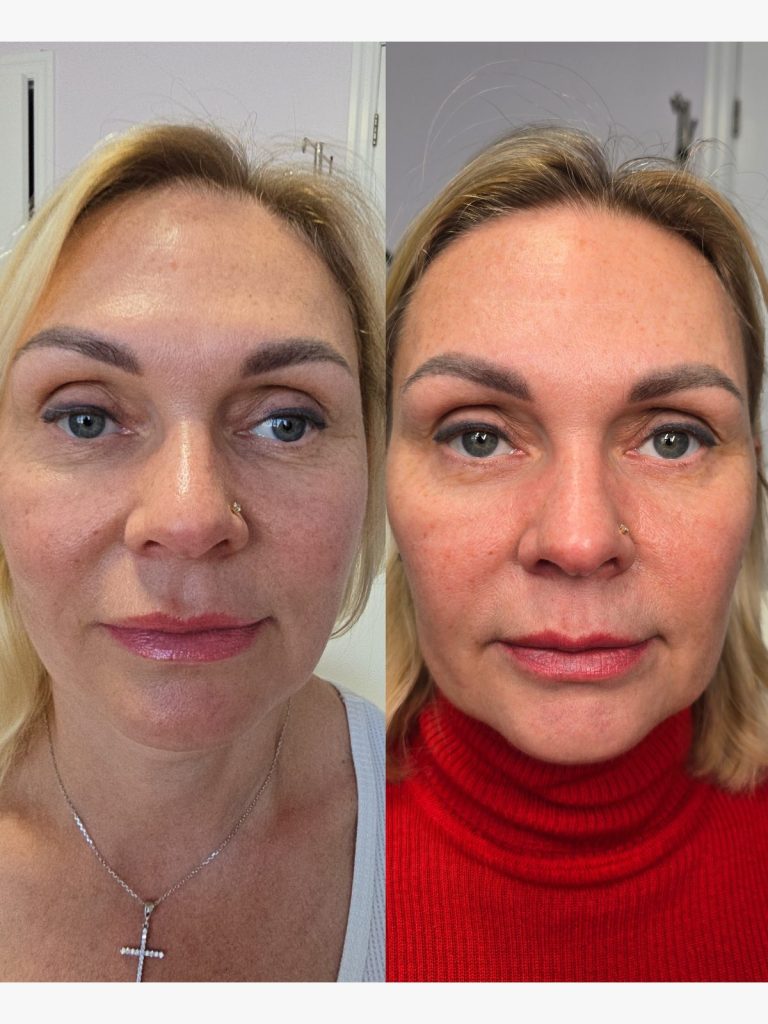
Photos of Beauty Maison Aesthetics clients, shared with consent. Individual results vary.
A simple way to tell which you need
Stand in front of a mirror in good daylight and ask yourself two questions.
1. If I gently lift my cheeks with my fingertips, does my face look more like I want it to? If yes, the issue is volume and support. Filler (or a collagen stimulator) is more likely to help.
2. If my skin looked more hydrated and smoother, but nothing moved, would I be happy? If yes, the issue is skin quality, and a skin booster is the better starting point.
Many people answer yes to both. That is normal from the mid-thirties onwards, and it is why the two treatments are often planned together — structure first, then skin quality — rather than as alternatives.
Can you combine skin boosters and filler?
Yes, and done in the right order they complement each other well. Filler restores the framework; a skin booster improves the surface that sits over it. Most clinicians space them a couple of weeks apart so that swelling from one does not confuse the assessment of the other.
If you are also considering microneedling or a chemical peel for texture or pigmentation, those can be scheduled around a booster course too. A good treatment plan sequences these rather than doing everything in one visit.
What about biorevitalization and mesotherapy?
You will see these terms alongside skin boosters. Biorevitalization generally refers to non-cross-linked hyaluronic acid injected to hydrate and stimulate the skin — very close to the skin booster idea. Mesotherapy uses tiny injections of vitamin, mineral and amino-acid blends, and can be used on the face or the scalp. The labels overlap; what matters is what goes in, how deep, and how often.
Regulatory status, in plain language
Hyaluronic acid fillers and boosters are regulated as medical devices in Canada, and each product is licensed for specific uses. Some skin booster uses are licensed indications; others are widely practised but off-label. You should always be told which applies to you before you consent — at Beauty Maison this is written on every service page, not just mentioned in passing.
Side effects and downtime
Both treatments involve needles, so small bruises are possible. With skin boosters, expect small raised bumps at each injection point for a few hours up to a day — they look a little like mosquito bites and flatten on their own. With filler, swelling is usually most noticeable for 24 to 48 hours and settles over about two weeks. Either way, avoid booking the day before an important event.
Serious complications are rare but real, particularly with filler, which is why the person treating you should be a regulated health professional trained in complication management and with hyaluronidase on hand.
Frequently Asked Questions
Ready to talk it through? Book a free, no-obligation consultation, or read more about skin boosters.